Dragon Tiger Live Game Analysis
Dragon Tiger is a live dealer casino game developed by Evolution Gaming. It is a simplified, two-card variant of Baccarat with an Asian theme, streamed in real-time from a dedicated studio. The game is known for its extremely fast-paced rounds and straightforward betting on which of two hands, Dragon or Tiger, will receive the higher card.
First released in 2020, Evolution's Dragon Tiger is recognized for its low-complexity gameplay that requires no strategic decision-making from the player. It is distinguished by its high-speed rounds, often completing within 20 to 25 seconds, and its clean, minimalist table interface designed for clarity and rapid betting.
Gameplay and Rules
Dragon Tiger gameplay is a direct comparison between two hands, each receiving a single card from a standard 52-card deck. Card rankings follow traditional order, with Ace being the lowest and King the highest. Suits are irrelevant for the main bets. The player's objective is to predict which hand, Dragon or Tiger, will win the round by having the higher card.
Each round follows a strict sequence. After betting time closes, the dealer draws one card for the Dragon position and one for the Tiger position from a shoe, typically containing multiple decks. The cards are revealed simultaneously. If both cards are of equal rank, the result is a Tie. Rounds are exceptionally quick, with sources noting durations of 15 to 25 seconds, facilitating a high-action gameplay tempo.
The game offers no player decisions or strategy beyond the initial bet placement. The outcome is determined entirely by chance, making it accessible to beginners. The rapid succession of rounds allows for continuous play without interruption.
Betting Options and Payouts
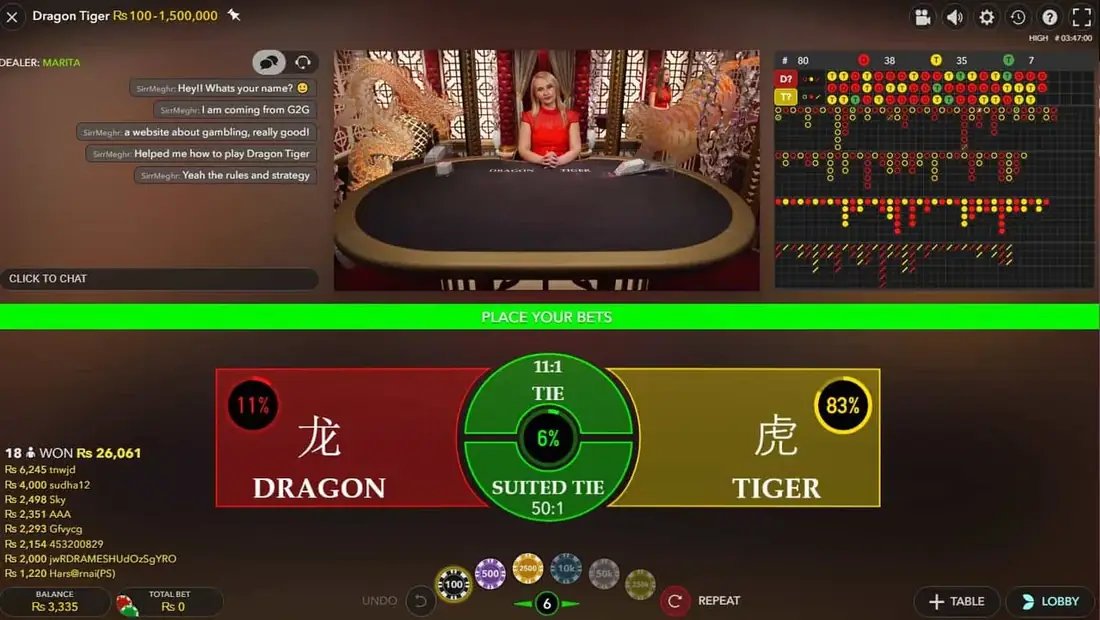
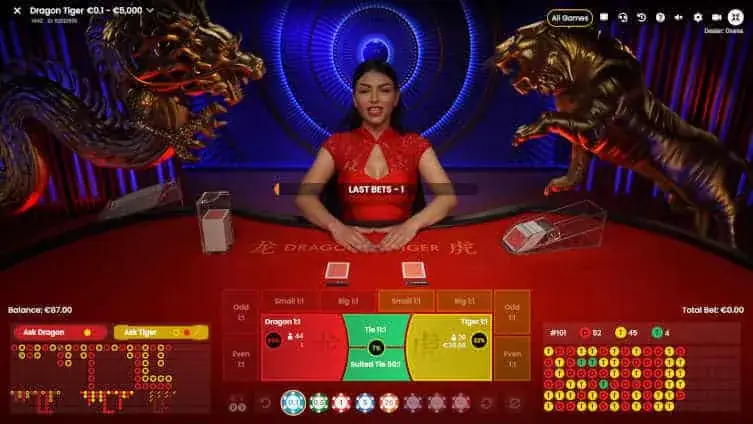
Players can place bets on three main outcomes: Dragon, Tiger, or Tie. The Dragon and Tiger bets pay out at even money (1:1) if the chosen side wins. The Tie bet offers a higher payout of 11:1. A fourth bet, the Suited Tie, pays 50:1 and wins only if the Tie occurs with both cards being of the same suit.
The main Dragon and Tiger bets carry the game's highest return to player (RTP) of 96.27%. The Tie and Suited Tie side bets have a lower RTP due to their higher payout odds, which increases the house edge. Players should note that the theoretical RTP can vary slightly depending on the number of decks in use and the specific rules of the studio.
| Bet | Payout | RTP |
|---|---|---|
| Dragon | 1:1 | 96.27% |
| Tiger | 1:1 | 96.27% |
| Tie | 11:1 | Lower than main bets |
| Suited Tie | 50:1 | Lower than main bets |
Studio Presentation and Format
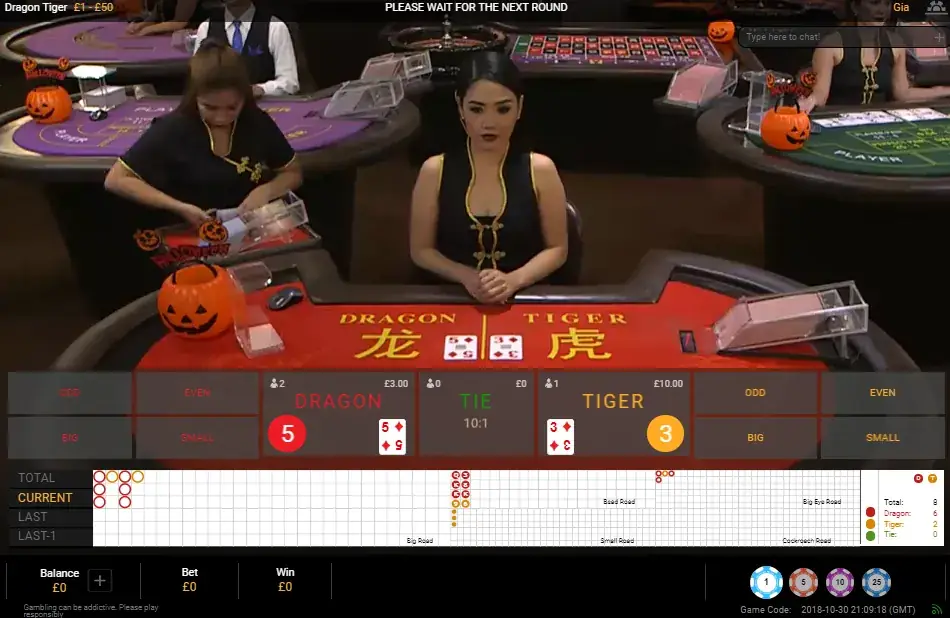
Evolution's Dragon Tiger is streamed live from a professional broadcast studio. The game is presented on a physical table with a real dealer, or croupier, who manages the card shoe and the pace of the game. The studio design often incorporates Asian-themed decor and subtle, relaxing background music to create an atmospheric experience.
The video feed is optimized for clarity, with high-definition cameras providing close-up views of the table and card dealings. The interface overlays betting chips and buttons digitally, allowing players to place bets on the live action. The dealer may interact with players via a live chat function, adding a social element to the game.
The format is strictly a live table game. It does not involve any video slot elements such as reels, paylines, or spinning symbols. The entire experience is centered on the real-time outcome of a physical card draw.
Key Specifications
Dragon Tiger is characterized by low volatility, meaning wins occur frequently but are typically at or near the even-money payout. The maximum win multiplier, as defined by the Suited Tie side bet, is 50 times the stake. The game accommodates a wide range of betting limits, making it suitable for both casual and high-stakes players.
| Specification | Detail |
|---|---|
| Game Type | Live Dealer Table Game |
| Developer | Evolution Gaming |
| Default RTP | 96.27% (Dragon/Tiger bets) |
| Volatility | Low |
| Maximum Win | 50:1 (Suited Tie bet) |
| Betting Range | $0.50 - $25,000 |
| Key Features | Dragon/Tiger/Tie/Suited Tie bets |
The minimum and maximum bet limits can vary between different online casino operators, though the figures above reflect the common range available.
First Person and Other Variants
Evolution also offers a First Person Dragon Tiger variant. This version uses computer-generated graphics (RNG) to simulate the game in a 3D environment, styled after a live casino table. It provides the same rules and betting options but allows for instant, single-player rounds without waiting for a live dealer stream. The RTP and low volatility are identical to the live version.
Other software providers have created their own interpretations of Dragon Tiger, often as live dealer games. It is important to distinguish these from similarly named video slots, such as Pragmatic Play's 'Dragon Tiger Fortunes', which is a 5-reel slot with free spins and jackpots. The live Dragon Tiger game has no bonus rounds, free spins, or wild symbols.
Strategy and Bankroll Considerations
As a pure game of chance with no player decisions, Dragon Tiger has no strategic depth akin to blackjack or poker. Any betting system or pattern does not affect the odds of winning. The only strategic consideration involves bet selection based on the game's statistical parameters.
The main Dragon and Tiger bets offer the highest RTP of 96.27%. The Tie and Suited Tie bets, while offering larger payouts, carry a significantly higher house edge. For players seeking to maximize theoretical returns, sticking to the main bets is recommended. The fast pace of the game necessitates careful bankroll management to avoid rapid depletion of funds during extended play sessions.
- Stick to Dragon or Tiger bets for the best RTP.
- Avoid frequent Tie and Suited Tie bets due to their lower return.
- Set loss limits and session durations before playing.
- Use the game's speed to your advantage by taking breaks between rounds.
Mathematical Structure and Betting Odds
The mathematical foundation of Dragon Tiger is remarkably straightforward, stemming from its use of a single standard 52-card deck. Each round, one card is dealt to the Dragon position and one to the Tiger position. The probability of either Dragon or Tiger winning a round, excluding the possibility of a tie, is nearly 50/50. However, the exact odds are adjusted by the house edge embedded in the payout structure. The even-money (1:1) payout for a correct Dragon or Tiger bet does not reflect true odds, which creates the game's profitability for the casino. The chance of a specific side winning is slightly less than 50% when the tie probability is accounted for.
The Tie bet, paying 11:1, is a more complex wager mathematically. The probability of a tie occurring, where both cards are of equal rank, is significantly lower than the probability of either Dragon or Tiger winning. While the 11:1 payout may seem attractive, the true odds of a tie are longer, resulting in a higher house edge compared to the main bets. This is why the Tie bet is associated with a lower RTP. The Suited Tie side bet, offering a 50:1 payout, is an even longer shot, requiring both cards to be of the same rank and the same suit. The frequency of this event is very low, which funds the large potential payout and similarly reduces the expected return to the player.
The game's low volatility is a direct result of this mathematical setup. The most frequent outcomes are the Dragon or Tiger wins at even money. These occur in the vast majority of rounds, leading to a steady stream of small wins and losses. The high-payout Tie and Suited Tie bets hit infrequently, contributing to the game's maximum win potential but not altering its fundamental low-risk profile.
No betting strategy can overcome this fixed mathematical framework. The game is dealt from a freshly shuffled shoe each round, making each deal an independent event. Patterns from previous rounds do not influence future outcomes. The only strategic consideration from a mathematical standpoint is the selection of which bet to place, understanding the different RTP percentages and associated risks. The Dragon and Tiger bets offer the best chance of sustained play due to their higher RTP and lower volatility, while the Tie and Suited Tie bets are high-risk, high-reward propositions with a greater long-term cost.
Return to Player Analysis and House Edge
The Return to Player (RTP) figure is a critical metric for understanding the theoretical long-term payout of a casino game. For Evolution's Dragon Tiger, the default RTP is 96.27%. This percentage represents the average amount of money returned to players over an extended period of play. A 96.27% RTP implies a house edge of 3.73%, which is a standard figure for many live table games. It is important to note that this is the optimal RTP, and some online operators may choose to run versions of the game with a lower return, as is common practice in the industry.
This RTP is not uniform across all betting options. The primary Dragon and Tiger bets, which pay at 1:1, are the primary drivers of this 96.27% figure. These bets offer the best odds for the player. The Tie bet, with its higher 11:1 payout, carries a significantly lower RTP, increasing the house edge. The Suited Tie side bet, offering a 50:1 payout, has an even lower RTP, making it a high-risk, high-reward proposition. Players should be aware that while side bets offer larger potential wins, they typically come at the cost of a higher house advantage.
The combination of this RTP with the game's low volatility creates a specific player experience. Low volatility means that wins occur frequently, but they are usually small, aligning with the even-money payouts of the main bets. The theoretical maximum win, as indicated by the Suited Tie bet, is 50 times the stake. This structure ensures a steady, fast-paced gameplay loop with regular, modest returns, punctuated by the rare possibility of a much larger win from a side bet. The game is engineered for sustained engagement rather than infrequent, massive jackpots.
Understanding the RTP helps contextualize the game's mathematical fairness. It provides a benchmark against which players can assess the cost of play. The 96.27% figure for the main bets is competitive within the live casino landscape. It is a fixed, calculable outcome based on the single-deck mechanics and the defined paytable. There is no player skill that can alter this percentage, as every round is an independent event. The RTP solidifies Dragon Tiger's position as a transparent game of chance with predictable statistical outcomes over time.
Technical Implementation and Game Features
Evolution's Dragon Tiger is implemented as a live table game, requiring significant technical infrastructure to deliver a seamless broadcast. The game is streamed from a professional studio, utilizing high-definition video and audio to create an authentic casino atmosphere. This technical setup involves physical tables, professional dealers, card shoes, and multiple camera angles to capture every detail of the card dealing process. The live format is designed to replicate the immediacy and transparency of a land-based casino, with the added convenience of online access.
The game's feature set is deliberately streamlined, focusing on core betting options. The primary bets are on Dragon, Tiger, or a Tie. The Suited Tie bet is offered as a side bet, paying 50:1 when the two cards dealt are of the same rank and suit. This side bet introduces an additional layer of excitement without complicating the fundamental rules. The betting interface is integrated into the video stream, allowing players to place wagers within a defined time window before the cards are dealt. The minimum and maximum bet limits are set at $0.50 and $25,000 respectively, accommodating a wide range of bankrolls.
From a software perspective, the game must handle real-time betting, secure financial transactions, and synchronize the live video feed with the digital interface. The RTP of 96.27% is hard-coded into the game's logic, governing the payout calculations. The low volatility is an inherent characteristic of the game's design, resulting from the high frequency of even-money outcomes. While some sources mention a 'First Person' variant that uses computer-generated graphics, the core live dealer version relies on the physical handling of cards, which is then digitized and transmitted to players' devices.
The technical specifications also influence the player experience. The game is noted for its speed, with rounds completing quickly, a factor enabled by the simple rules and efficient dealer actions. The studio presentation, including themed decor and sound design, contributes to the overall ambiance but does not affect the game's mechanics. All outcomes are determined by the physical draw of cards from a standard 52-card deck, with the technology serving solely as a delivery and facilitation platform. This ensures the game's integrity remains rooted in traditional chance, enhanced by modern streaming capabilities.
Target Audience and Reception
Dragon Tiger is primarily aimed at players seeking a simple, fast-paced casino experience with minimal rules. Its appeal lies in its immediacy and the low barrier to entry, making it popular among beginners and those who prefer games based purely on luck rather than skill. The live dealer format adds a layer of authenticity and social interaction appreciated by players looking for a realistic casino atmosphere.
The game has been well-received for its streamlined design and reliability. It is considered a staple in the live casino portfolios of many online operators. It is less suited for players who enjoy complex strategy, deep decision-making, or the extended feature rounds common in video slots.
Strengths
- Extremely fast-paced and simple gameplay
- High 96.27% RTP on main bets
- Wide betting range suits all bankrolls
- Authentic live dealer studio presentation
- Fully optimized for mobile play
Weak points
- No strategic depth or player decisions
- Side bets have a high house edge
- Rapid rounds can lead to fast bankroll depletion
Dragon Tiger: questions and answers
What is the RTP of Dragon Tiger by Evolution?
The return to player (RTP) for the main Dragon and Tiger bets is 96.27%. The Tie and Suited Tie side bets have a lower RTP, which increases the house edge. Operators may occasionally run versions with a different RTP.
What is the maximum win in Dragon Tiger?
The maximum payout is 50 times your stake, achieved by winning the Suited Tie side bet. This requires a Tie where both the Dragon and Tiger cards are of the same suit.
Is Dragon Tiger a slot machine?
No, Dragon Tiger is not a slot. It is a live dealer card game streamed from a studio, involving real cards and a dealer. It has no reels, paylines, or bonus free spins rounds.
What is the difference between Dragon Tiger and Baccarat?
Dragon Tiger is a simplified derivative of Baccarat. Instead of multiple cards and complex drawing rules, each side receives only one card, and the higher card wins. This makes rounds much faster and the rules easier to follow.
Can I play Dragon Tiger on my phone?
Yes, Evolution's Dragon Tiger is fully optimized for mobile devices. The live stream and betting interface adapt to smartphones and tablets, allowing for full functionality on the go.
Is there a strategy for winning at Dragon Tiger?
There is no strategic gameplay, as the outcome is entirely random. The only strategic consideration is bet selection: the Dragon and Tiger bets offer a higher RTP than the Tie side bets.
What are the betting limits?
Betting limits commonly range from a minimum of $0.50 to a maximum of $25,000 per round. Exact limits can vary depending on the online casino operator hosting the game.